
How to Decide What to Automate First in a Call Center (Without Breaking CX)
Not sure where to start with call center automation? Learn how to identify the first processes to automate, avoid common mistakes, and improve efficiency without hurting customer experience.

Latest articles
The Most Common AI Automation Mistakes in Call Centers — And How Smart Teams Avoid Them
Introduction: Automation Fails When You Start in the Wrong Place
Call center automation promises faster resolution times, lower costs, and happier agents. But many teams struggle to see results — not because automation doesn’t work, but because they automate the wrong things first.
The most successful call centers don’t start by asking what AI can do. They start by asking where friction actually lives. Automating without clarity only speeds up confusion.
This guide explains how to decide what to automate first in a call center, using practical criteria that protect customer experience while delivering real operational gains.
Why “Automate Everything” Is the Fastest Way to Fail
Automation amplifies whatever already exists in your operation.
If a process is:
unclear
inconsistent
emotionally sensitive
or decision-heavy
automation will make it more visible, not better.
That’s why teams often end up with:
frustrated customers stuck in loops
agents overwhelmed by escalations
leaders becoming the final bottleneck
The goal of early automation is not scale.
It’s stability.
The Automation Readiness Filter: 4 Questions to Ask First
Before automating any process, run it through these four filters:
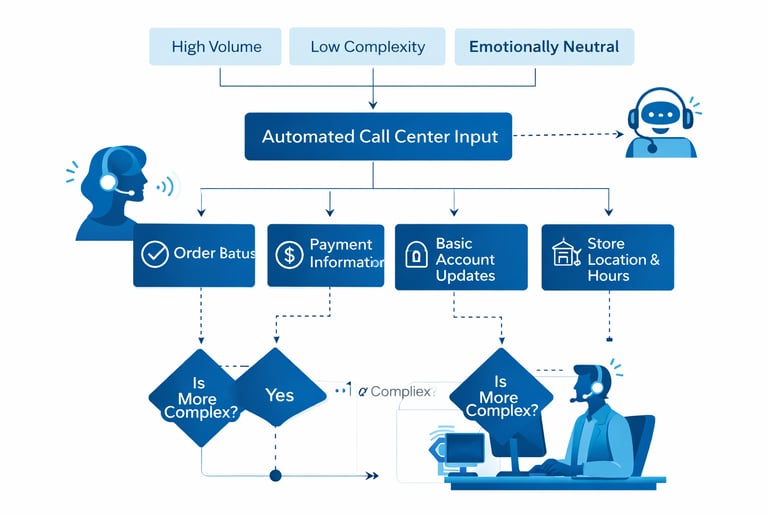
1. Is the volume high?
If an interaction happens hundreds or thousands of times per month, it’s a strong candidate.
2. Is the complexity low?
The best early automations follow predictable paths with few exceptions.
3. Are emotional stakes low?
Speed matters more than empathy for some interactions — not all.
4. Is the decision already made?
If humans are just routing, copying, or confirming, automation will shine.
When all four answers are “yes,” you’ve found your starting point.
What Call Centers Should Automate First
Early-stage automation should focus on relieving pressure, not replacing humans.
The strongest first candidates usually include:
Order status and delivery updates
Appointment confirmations and reminders
Account balance or basic information requests
Store hours, locations, or availability checks
Password resets and simple account updates
These interactions share three traits:
high volume, low emotional load, and clear outcomes.
What You Should Not Automate (At Least Not Yet)
Knowing what to avoid is just as important.
Delay automation for:
emotionally charged complaints
escalations and VIP customers
complex multi-step issues
situations where exceptions are common
These interactions require empathy, judgment, and flexibility — areas where humans still outperform AI.
Automating them too early damages trust and increases churn.
The 80/20 Rule in Call Center Automation
In most call centers:
~80% of calls fall into ~20% of categories
This is where automation delivers the fastest ROI.
Automate the 20% of interactions that create 80% of repetitive workload, and leave the remaining 20% for skilled agents who can add real value.
Start Small: Why Pilot Projects Win
Successful teams don’t launch automation everywhere.
They:
choose one use case
pilot it for 4–8 weeks
measure containment, CSAT, and escalation rates
refine before expanding
This reduces risk and builds internal trust.
Automation is a program, not a switch.
Metrics That Tell You If You Chose Correctly
If you automated the right process first, you should see:
lower average handle time (AHT)
reduced inbound volume
higher first-contact resolution
fewer agent interruptions
stable or improved CSAT
If escalations spike or customers complain, you automated too close to emotion or ambiguity.
Automation Is About Removing Decisions, Not Just Tasks
The highest-leverage automation doesn’t just save time.
It removes:
repeated approvals
constant clarifications
manual routing decisions
When systems can decide without escalation, leaders stop being bottlenecks and agents stop being routers.
That’s when automation actually feels like relief.
Final Thoughts: Automate for Stability First, Scale Later
The question isn’t how much you automate.
It’s where you start.
Automate interactions that are:
repetitive
predictable
low-risk
decision-stable
Protect human agents for moments that require empathy and judgment.
Call centers that follow this path don’t just reduce costs — they build systems that scale without chaos.


What should a call center automate first?
High-volume, low-complexity interactions like order status, reminders, and basic account requests.
FAQs
Should all calls be automated eventually?
No. Emotional, complex, and high-value interactions should remain human-led.
How do you know if automation is working?
Look for reduced handle times, fewer escalations, and stable customer satisfaction.
Does automation replace agents?
No. It removes repetitive work so agents can focus on what humans do best.


About ManuOps
This blog explores how artificial intelligence is improving modern call centers, with a focus on real-world applications, customer experience, and human–AI collaboration.
Contact
Questions? Reach out anytime.
Links
contact@manuops.io
© 2025 ManuOps. All rights reserved.