
The Most Common AI Automation Mistakes in Call Centers — And How Smart Teams Avoid Them
AI automation can transform call centers — or quietly make things worse. Learn the most common AI automation mistakes and how to avoid them in practice.


AI automation is everywhere in call centers. Routing, voice bots, QA, summaries, coaching — it all sounds like a guaranteed win.
But in reality, many AI initiatives don’t fail loudly.
They fail quietly.
Agents stop trusting the system.
Customers repeat themselves.
Metrics look fine, but experience gets worse.
The problem isn’t the technology.
It’s how automation is introduced, scoped, and measured.
This article breaks down the most common AI automation mistakes call centers make, why they happen, and how to avoid them without slowing innovation or overwhelming your teams.
Mistake #1: Automating Broken Processes
One of the fastest ways to fail with AI is automating workflows that are already broken.
If your call routing logic is unclear, AI will route faster — but still incorrectly.
If agents already struggle with knowledge gaps, automation will just scale inconsistency.
AI doesn’t fix bad processes.
It amplifies them.
How to avoid it
Before automation, ask:
Does this process make sense to a new human agent?
Is it documented and repeatable?
Are handoffs clear?
Fix the workflow first.
Then automate it.
Mistake #2: Trying to Automate Everything at Once
Big bang rollouts look impressive in slides — and fail in production.
Call centers that launch bots, AI routing, QA automation, and coaching simultaneously often lose visibility into what’s working and what’s breaking.
When everything changes at once:
Agents feel overwhelmed
Adoption drops
Debugging becomes guesswork
How to avoid it
Start with one high-impact, low-risk use case, such as:
Call summaries
Simple intent routing
QA coverage expansion
Prove value.
Then scale.
Mistake #3: Ignoring Agent Buy-In
Automation fails faster when agents see AI as a threat instead of support.
If agents believe:
AI is monitoring them unfairly
Automation is replacing them
Decisions are made by a black box
They will resist — consciously or unconsciously.
No adoption means no ROI.
How to avoid it
Involve agents early in pilots
Be explicit about what AI will not do
Use AI to reduce busywork, not increase scrutiny
AI works best when agents feel backed up, not watched.
Mistake #4: Measuring the Wrong Metrics
Many call centers judge AI success using the wrong signals.
Lower cost per contact doesn’t always mean better experience.
Faster calls don’t always mean resolved calls.
When automation is measured only on efficiency:
Customer frustration increases
Repeat calls rise
Agents do more cleanup work
How to avoid it
Balance efficiency metrics with experience metrics:
First Call Resolution
Escalation quality
Customer effort signals
Agent rework time
If AI looks good on dashboards but hurts reality, it’s not working.
Mistake #5: Expecting AI to Replace Human Judgment
AI is excellent at patterns.
Humans are better at nuance.
When call centers push AI to handle:
Emotional calls
Complex exceptions
Multi-issue conversations
The experience breaks.
Customers escalate anyway — now frustrated.
How to avoid it
Design AI as a support layer, not a replacement:
Automate the predictable
Assist the complex
Escalate early when confidence drops
Hybrid models outperform pure automation every time.
Mistake #6: Treating AI as “Set and Forget”
Customer language changes.
Products change.
Regulations change.
AI models don’t magically adapt on their own.
Without continuous tuning:
Accuracy drops
False positives rise
Trust erodes
How to avoid it
Schedule regular model reviews
Feed agent feedback back into training
Monitor edge cases, not just averages
AI automation is an ongoing system — not a one-time install.
Mistake #7: Ignoring Data Quality and Context
AI is only as good as the data it sees.
Messy transcripts, outdated CRM fields, or missing context lead to:
Wrong routing
Poor intent detection
Misleading QA scores
Automation built on weak data creates false confidence.
How to avoid it
Clean and standardize data before rollout
Integrate systems so AI sees full context
Audit inputs regularly, not just outputs
Good data is the hidden foundation of good automation.
Turning AI Automation Into a Competitive Advantage
Most AI automation failures don’t come from bad tools.
They come from:
Rushing rollout
Skipping fundamentals
Measuring the wrong things
Forgetting the humans in the system
Call centers that succeed with AI do a few things consistently:
Start small
Design for agents, not against them
Measure real outcomes
Iterate continuously
AI doesn’t need to be perfect.
It needs to be useful, trusted, and aligned with reality.


Why does AI automation fail in call centers?
Because of poor rollout, unclear goals, low agent adoption, weak data, or unrealistic expectations — not because AI doesn’t work.
FAQs
Should call centers automate everything?
No. Automation works best for repetitive, predictable tasks. Complex or emotional interactions still need humans.
What is the safest way to start with AI automation?
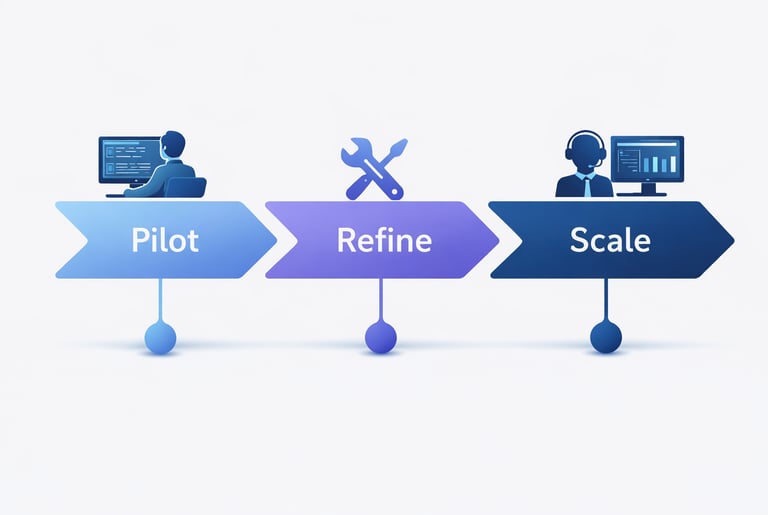
Start with a single use case, pilot it, measure impact, and scale gradually.


About ManuOps
This blog explores how artificial intelligence is improving modern call centers, with a focus on real-world applications, customer experience, and human–AI collaboration.
Contact
Questions? Reach out anytime.
Links
contact@manuops.io
© 2025 ManuOps. All rights reserved.