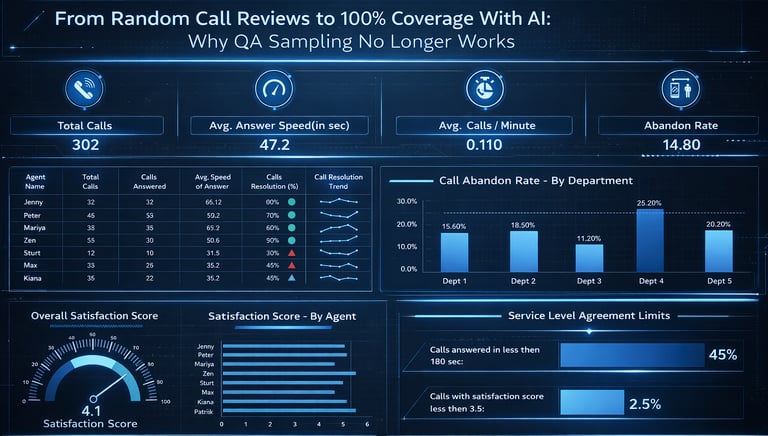
From Random Call Reviews to 100% Coverage With AI: Why QA Sampling No Longer Works
Move beyond random call sampling. Learn how AI-driven quality assurance delivers 100% coverage, detects risk in real time, and transforms compliance and agent performance.
Introduction: The Illusion of “Enough” QA
For years, call center quality assurance has relied on a simple assumption: reviewing a small sample of calls is enough to understand overall performance.
In reality, that assumption is quietly damaging customer experience, compliance, and operational visibility.
When QA teams review 1–5% of interactions, most conversations go unheard. Compliance risks surface late. Coaching arrives weeks after the problem happened. And leadership makes decisions based on partial data.
AI changes this equation completely.
Instead of guessing quality from random samples, modern QA systems can analyze 100% of customer interactions, continuously and objectively. The result is not just better QA—it’s a fundamentally different way of managing risk, performance, and trust.
Why Random Call Sampling Fails at Scale
Random sampling was designed for a world with low call volumes and limited technology. Today, it breaks under pressure.
Sampling creates blind spots that teams rarely see until it’s too late. Critical compliance violations may occur outside the reviewed sample. Poor experiences during night shifts or peak hours go unnoticed. High-performing agents can develop bad habits without timely feedback.
Most importantly, sampling delays learning. By the time QA identifies a pattern, the damage has already spread across dozens or hundreds of calls.
QA teams are not failing. The method is.
What Changes When QA Reaches 100% Coverage
When every interaction is evaluated, quality assurance stops being reactive.
Instead of asking “Which calls should we review?”, teams can ask:
Where are customers struggling right now?
Which agents need support today, not next month?
What compliance risks are emerging across channels?
Full coverage transforms QA from a policing function into an intelligence layer that supports agents, supervisors, and leadership simultaneously.
How AI Enables 100% Call Coverage
AI-driven QA platforms rely on several core capabilities working together.
First, automated transcription converts every call into structured, searchable data. This makes conversations analyzable at scale, regardless of volume.
Next, natural language processing evaluates tone, intent, keywords, and conversational flow. The system can identify missed disclosures, risky language, emotional escalation, or process deviations without human intervention.
Finally, automated scoring applies consistent quality standards to every interaction. There is no evaluator bias, fatigue, or inconsistency—every call is judged against the same criteria.
The result is complete visibility, in real time.
Real-Time Risk Detection Instead of Late Discovery
One of the most important shifts with AI-based QA is timing.
Traditional QA finds problems days or weeks later. AI detects them as they happen.
When a customer becomes frustrated, when an agent skips a required disclosure, or when a conversation trends toward escalation, supervisors can be alerted immediately. This allows for live intervention, fast coaching, or corrective follow-up before the issue becomes a complaint or regulatory problem.
Compliance stops being a post-mortem activity and becomes a living safeguard.
From Manual Scoring to Intelligent Coaching
Full coverage alone is not enough. The real value comes from what teams do with the insights.
AI-powered QA highlights patterns humans struggle to see:
Repeated mistakes across different agents
Knowledge gaps tied to specific products or policies
Performance drops during certain hours or workloads
Language patterns linked to churn or dissatisfaction
This data turns coaching into a precise, personalized process. Agents receive specific feedback tied to real conversations, not generic advice. Managers spend less time reviewing calls and more time developing people.
Why 100% Coverage Matters for Compliance
In regulated industries, partial monitoring is a liability.
Every unreviewed call is a potential compliance risk. Disclosures may be missed. Vulnerable customers may not be identified. Inconsistent language can create regulatory exposure.
AI-driven QA ensures that compliance standards are enforced consistently across every interaction, not just the ones selected for review. This reduces risk, strengthens audit readiness, and builds confidence with regulators and internal stakeholders alike.
Operational Impact Beyond QA
The benefits of full QA coverage extend far beyond quality teams.
Leadership gains accurate visibility into customer experience trends. Training teams can align programs with real performance gaps. Product teams can hear recurring customer objections and confusion directly from conversations. Customer success teams can detect churn signals earlier.
QA becomes a shared source of truth across the organization.
When Does AI QA Make Sense?
If your operation handles more than a few thousand interactions per month, random sampling is already working against you.
The more volume you have, the more value full coverage delivers. AI scales without adding headcount, without increasing review time, and without sacrificing consistency.
What once required large QA teams can now be handled continuously and automatically—without losing the human layer where it matters most.
The Future of Quality Assurance
Quality assurance is no longer about checking boxes after the fact.
It is becoming a real-time, intelligence-driven system that protects customers, supports agents, and strengthens compliance across every channel.
Random call reviews belong to a different era.
100% coverage with AI is quickly becoming the baseline.
The question is no longer if organizations will adopt it—but how long they can afford to wait.

About ManuOps
This blog explores how artificial intelligence is improving modern call centers, with a focus on real-world applications, customer experience, and human–AI collaboration.
Contact
Questions? Reach out anytime.
Links
contact@manuops.io
© 2025 ManuOps. All rights reserved.