
AI vs Human Agents in Call Centers: What Each Does Best (And Why Hybrid Models Win)
AI agents deliver speed and scale. Human agents bring empathy and judgment. This guide explains when to use each — and why hybrid call centers perform best.
Latest articles
How AI Reduces Call Center Costs (Real-World Scenarios)
Introduction: Why “AI vs Human” Is the Wrong Question
The discussion around AI versus human agents is often framed as a replacement debate. The assumption is that automation will eventually eliminate the need for people in call centers. In reality, that is not what is happening. Modern call centers are moving toward hybrid operating models that combine artificial intelligence with human expertise in a structured and intentional way.
AI is transforming how fast calls are answered, how much support costs, and how widely service can scale. At the same time, human agents continue to define trust, empathy, and judgment in moments that matter most to customers. The real competitive advantage no longer comes from choosing one over the other, but from understanding where each performs best and how they work together.
This article explains the real strengths and limitations of AI agents and human agents, and why hybrid call center models consistently outperform setups that rely on only one.
What Are AI Agents in Call Centers?
AI agents are software-driven systems that handle customer interactions using natural language processing, machine learning, and workflow automation.
They are commonly used for:
FAQs and routine inquiries
Call routing and triage
Order status, billing, and account checks
Voice bots and chatbots available 24/7
AI agents excel in speed, consistency, and scale, especially when interactions follow predictable patterns.
What Human Agents Do Best
Human agents remain essential wherever context, emotion, or judgment matters.
They are strongest at:
Emotionally sensitive conversations
Complex or ambiguous problems
Negotiation, retention, and trust-building
Handling edge cases outside defined rules
Human agents don’t just answer questions — they interpret intent, emotion, and nuance.
Where AI Agents Clearly Win
AI agents perform best when volume and speed are the primary concerns. In high-traffic environments where customers are asking repetitive or straightforward questions, automation acts as an effective first line of support.
By handling routine requests instantly, AI reduces call abandonment, shortens average handle time, and prevents human agents from being overwhelmed by low-value interactions. This not only improves operational efficiency but also reduces burnout among support teams by allowing them to focus on more meaningful work.
Where Human Agents Are Still Essential
Human agents are irreplaceable when interactions involve complaints, escalations, or emotionally charged situations. Customers dealing with complex issues, policy exceptions, or high-stakes decisions often care less about speed and more about being understood.
In these scenarios, empathy, judgment, and trust matter far more than instant responses. Human agents are better equipped to manage nuance, de-escalate tension, and preserve customer relationships that might otherwise be lost through rigid automation.
How to Decide What Your Call Center Needs
Use this rule of thumb:
Choose AI when:
Requests are repetitive
Volume is high
Speed matters more than nuance
Choose humans when:
Emotions are involved
Stakes are high
Context is unclear
Choose hybrid when:
You want scale without losing CX
You need cost control and trust
For most teams, hybrid is not optional — it’s the only sustainable model.
Final Thoughts
AI agents bring efficiency, speed, and scalability to call centers. Human agents bring empathy, adaptability, and trust. Organizations that understand where each one fits outperform those that rely on extremes.
The winning strategy is not AI versus human agents.
It is AI working with humans, used intentionally and strategically.
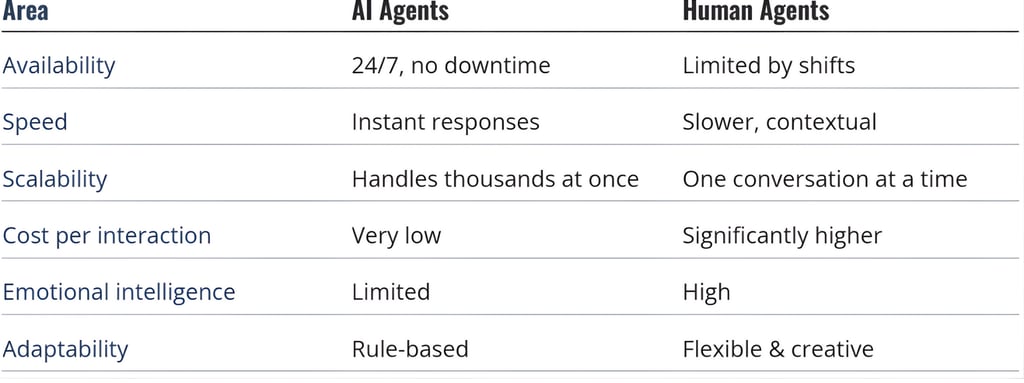
Core Differences Between AI and Human Agents



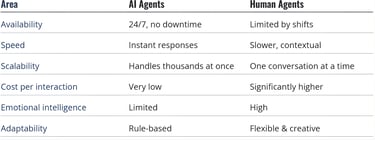
Why Hybrid Call Centers Perform Best
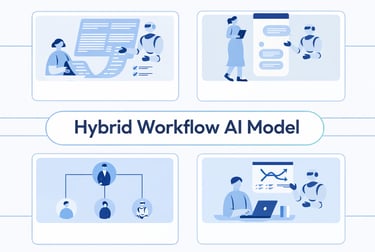
The highest-performing call centers no longer choose AI or humans. They design hybrid workflows.
Typical hybrid model:
AI handles first contact
AI resolves routine issues
Complex cases escalate to humans
Context transfers automatically
Humans supervise and improve AI
This approach delivers:
Faster resolution
Lower costs
Higher CSAT
Better agent experience
The Future of AI and Human Agents
AI will continue to improve in language understanding, automation, and decision support. Its role in call centers will expand as models become more accurate and better integrated with business systems. However, human agents will remain critical wherever judgment, ethics, and emotional intelligence are required.
The future of customer support is not replacement. It is collaboration by design.
About ManuOps
This blog explores how artificial intelligence is improving modern call centers, with a focus on real-world applications, customer experience, and human–AI collaboration.
Contact
Questions? Reach out anytime.
Links
contact@manuops.io
© 2025 ManuOps. All rights reserved.