
Why Call Abandonment Is Killing Your CX — And How AI Fixes It Fast
Call abandonment frustrates customers and destroys conversions. See why it happens and how AI reduces abandonment with smart routing, callbacks, and predictive queue management.

Latest articles
How AI Is Improving Call Centers in 2026
When customers hang up before speaking to an agent, they’re not just impatient — they’re telling you that waiting feels harder than switching brands.
In modern call centers, abandonment isn’t caused by a single issue. It’s the result of outdated systems struggling to keep up with real customer expectations. The good news is that AI has become one of the fastest and most effective ways to reverse this trend.
This article explains what call abandonment really is, why it happens, and how AI reduces it in practical, measurable ways.
What Is Call Abandonment?
Call abandonment occurs when a caller disconnects before reaching a live agent or resolving their issue.
It typically happens during:
Long hold times
Confusing IVR menus
Call transfers or silence
After-hours calls with no clear next step
Most call centers track this as Call Abandonment Rate, a critical CX metric tied directly to:
Customer satisfaction (CSAT)
Conversion rates
Revenue retention
Brand trust
A high abandonment rate doesn’t mean customers are difficult.
It means your system is asking too much patience.
Why Call Abandonment Happens
1. Long and Unpredictable Wait Times
Customers rarely know how long they’ll wait — and uncertainty kills patience faster than time itself.
2. Poor Call Routing
Being transferred multiple times or sent to the wrong department creates frustration and repetition.
3. Call Volume Spikes
Marketing campaigns, outages, billing cycles, or seasonal demand can overwhelm queues without warning.
4. After-Hours Dead Ends
Customers don’t stop needing help just because business hours end.
5. Rigid IVR Systems
Traditional IVRs force callers into menus instead of understanding intent — increasing friction from the first second.
How AI Reduces Call Abandonment Rates
AI doesn’t fix abandonment by “working harder.”
It fixes it by removing friction before frustration appears.
Here are the most effective AI-driven approaches.
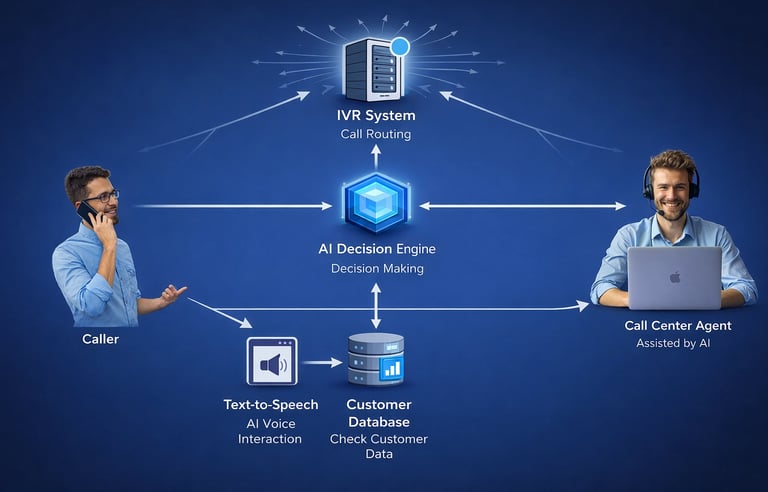
Smart Routing Based on Intent
AI-powered call routing understands why someone is calling — not just which number they press.
Instead of:
“Press 1 for billing, press 2 for support…”
AI listens to natural language and routes calls based on:
Caller intent
Urgency
History
Agent availability and skill set
This dramatically reduces misroutes, transfers, and repeat explanations — all major causes of abandonment.
AI Callbacks That Replace Waiting
One of the biggest breakthroughs in CX is AI-managed callbacks.
Instead of waiting on hold, customers can:
Request a callback
Keep their position in the queue
Get contacted automatically when an agent is available
AI ensures callbacks actually happen — at the right time — eliminating the “I’ll try again later” problem that often leads to permanent drop-off.
Voice Bots for After-Hours Coverage
Abandonment spikes outside business hours because customers hit a dead end.
AI voice bots change this by:
Answering calls 24/7
Handling common requests immediately
Collecting information for next-day follow-up
Routing urgent issues when needed
Even when a human agent isn’t available, the call still moves forward.
Predictive Queue Management
AI doesn’t just react to queues — it predicts them.
By analyzing historical data and real-time conditions, AI can:
Forecast call spikes
Adjust routing rules dynamically
Prioritize high-risk calls
Balance agent workloads before queues explode
This prevents abandonment before customers even realize they would’ve waited.
The CX Impact: What Actually Changes
When AI Makes the Biggest Difference
AI-driven abandonment reduction is especially impactful in high-volume call centers, support teams facing unpredictable spikes, businesses with after-hours demand, and sales or lead qualification teams where speed directly affects revenue. In any operation where time-to-answer matters, AI stops being a nice-to-have and becomes corrective.
If customers are hanging up today, AI is no longer optional.
Final Thoughts: From Waiting to Winning
Call abandonment isn’t a customer behavior problem. It’s a system design problem.
AI fixes abandonment by removing uncertainty, reducing friction, and meeting customers where they are, instantly and intelligently. When calls stop ending in silence, customer experience stops being a liability and starts becoming a competitive advantage.
And once customers realize they don’t have to wait anymore, they don’t go back.


When AI reduces call abandonment, the effects compound quickly. Customers experience shorter perceived wait times, fewer frustrating interactions, and faster resolutions. Agents become more efficient because they handle fewer misrouted or repetitive calls. Conversion rates and retention improve as fewer opportunities are lost to hang-ups. Most importantly, customers feel respected instead of ignored.
What is an acceptable call abandonment rate?
Most industries aim for 5% or lower, but top-performing CX teams often stay below 3%.
FAQs
Can AI really reduce abandonment without adding agents?
Yes. AI reduces abandonment by routing better, answering instantly, and handling overflow — not by increasing headcount.
Is AI only useful for large call centers?
No. Small and mid-sized teams often see faster ROI because AI absorbs volume they can’t staff for.
Do customers accept AI on phone calls?
When implemented well, AI reduces frustration by eliminating waiting — which customers value more than speaking to a human immediately.


About ManuOps
This blog explores how artificial intelligence is improving modern call centers, with a focus on real-world applications, customer experience, and human–AI collaboration.
Contact
Questions? Reach out anytime.
Links
contact@manuops.io
© 2025 ManuOps. All rights reserved.