
How AI Is Improving Call Centers in 2026
Discover how AI is improving call centers in 2026, from voice AI and predictive analytics to smarter customer experiences and human-AI collaboration.


Latest articles
How AI Reduces Call Center Costs (Real-World Scenarios)
For decades, call centers have been associated with long wait times, frustrating IVR menus, high operational costs, and overwhelmed agents. But in 2026, that perception is rapidly changing. Artificial Intelligence (AI) is no longer a supporting tool in customer service — it has become a core driver of efficiency, personalization, and scalability.
Today’s AI-powered call centers are smarter, faster, and more human than ever before. From conversational voice agents to predictive analytics and real-time agent assistance, AI is transforming how contact centers operate and how customers experience support.
This article explores how AI is transforming call centers in 2026, the key technologies behind the shift, the real problems it solves, and what this evolution means for the future of customer experience.
Why Traditional Call Centers Could No Longer Keep Up
Before understanding the transformation, it’s important to look at the challenges that forced change.
Traditional call centers struggled with:
Static IVR systems that frustrated customers
Long hold times and inefficient call routing
High staffing and training costs
Inconsistent service quality
Limited visibility into call performance and compliance
Difficulty scaling during peak demand
Customer expectations evolved faster than call center technology. People now expect instant, personalized, and seamless support — and legacy systems simply couldn’t deliver that at scale.
AI emerged not as a luxury, but as a necessity.
What an AI-Powered Call Center Looks Like in 2026
An AI-powered call center in 2026 is fundamentally different from its predecessors. Instead of reacting to customer calls, it actively understands, predicts, and optimizes every interaction.
These environments combine speech recognition, natural language processing, conversational AI, and machine learning to interpret intent and context in real time. AI systems continuously learn from past interactions, improving accuracy and performance with every conversation. When connected to CRM platforms and internal systems, they gain a complete, real-time view of the customer.
The result is a contact center that no longer depends on rigid scripts or manual processes. It adapts dynamically to customer needs, delivering faster resolutions and more consistent experiences.
From Rigid IVRs to Natural Conversations
One of the most visible changes driven by AI is the evolution of IVR systems.
Traditional IVRs forced customers into predefined paths, requiring them to press buttons and navigate menus that often led nowhere. These systems had no real understanding of intent or context, which made even simple requests frustrating.
In 2026, AI-driven IVRs allow customers to speak naturally. Voice AI understands intent, sentiment, and context, routing calls intelligently or resolving issues instantly without human intervention.
Benefits include:
Faster resolution times
Reduced call abandonment
Improved first-call resolution
Dramatically better customer experience
AI Voice Agents and Always-On Support
AI voice agents have become one of the most impactful innovations in modern call centers.
These agents handle large volumes of repetitive inquiries around the clock, without fatigue or variability in performance. They deliver consistent, compliant responses while instantly accessing large knowledge bases that would take human agents far longer to navigate.
By managing tasks such as appointment scheduling, order tracking, account updates, or basic service inquiries, AI voice agents remove a significant operational burden. This allows human agents to focus on complex, high-value conversations where empathy, judgment, and trust play a critical role.

From Human Agents to AI Co-Pilots
AI in 2026 is not about replacing agents — it’s about augmenting them.
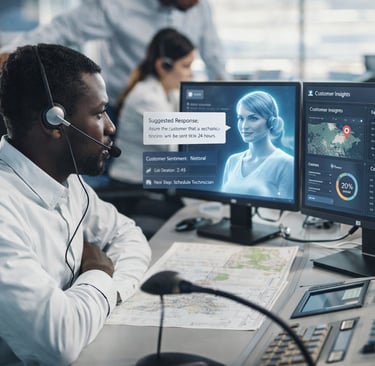
AI as a Real-Time Assistant
During live calls, AI co-pilots can:
Suggest responses and next-best actions
Pull relevant customer data instantly
Summarize conversations automatically
Detect sentiment and escalation risk
This reduces cognitive load, shortens handling times, and improves agent confidence — especially for newer or less experienced staff.
Agents spend less time navigating systems and more time building meaningful connections with customers.
Predictive Analytics: From Reactive to Proactive Support
Traditional call centers react to problems after customers complain. AI changes that dynamic completely.
Using predictive analytics, AI systems analyze:
Past interactions
Customer behavior patterns
Sentiment trends
Operational data
This allows call centers to:
Anticipate issues before they escalate
Identify customers at risk of churn
Forecast call volume more accurately
Trigger proactive outreach
In 2026, the most successful call centers don’t just answer calls — they prevent them.
Automated Quality Assurance and Compliance
Quality assurance has also undergone a major transformation.
In the past, QA teams reviewed only a small sample of calls, leaving most interactions unexamined. AI now makes it possible to analyze every single conversation.
AI-powered QA systems automatically score calls, detect compliance risks, identify coaching opportunities, and flag potential issues in real time. This is especially critical in regulated industries such as finance, healthcare, and insurance, where even small compliance failures can have serious consequences.
By delivering full visibility and consistency without manual effort, AI-driven QA improves both performance and accountability.
Cloud-Based and Scalable Call Center Operations
AI transformation is closely tied to cloud infrastructure.
By 2026, most AI-enabled call centers operate on cloud platforms that support rapid scalability, seamless integration of AI tools, and remote or hybrid workforces. These platforms provide high availability, redundancy, and strong security controls while allowing organizations to adapt quickly to changing demand.
Cloud-based AI removes many of the physical and technical constraints that once limited call center growth, making innovation faster and more accessible.
Human + AI: The Real Future of Call Centers
A key theme across the industry is clear:
The future is not human vs AI — it’s human empowered by AI.
AI excels at:
Speed and accuracy
Pattern recognition
High-volume processing
24/7 availability
Humans excel at:
Empathy and emotional intelligence
Complex decision-making
Contextual understanding
Trust and relationship-building
In 2026, the most effective call centers combine both strengths into a hybrid workforce, where AI handles the noise and humans handle the nuance.
Challenges and Considerations
Despite its advantages, AI adoption is not without challenges. Poorly trained AI can frustrate customers, while excessive automation risks removing the human touch from sensitive interactions. Data privacy, governance, and ethical use of AI must be handled carefully, and agents need proper training to work effectively alongside intelligent systems.
Successful transformation depends on thoughtful implementation, continuous optimization, and a clear focus on people — not just technology.
What Call Centers Should Focus on Today
To prepare for the future, organizations should:
Start with clear business goals, not just technology
Integrate AI gradually, not all at once
Invest in workforce upskilling and AI literacy
Prioritize data quality and system integration
Balance automation with human empathy
AI maturity is a journey, not a switch.
Conclusion: The Intelligent Call Center Era
By 2026, AI has transformed call centers from cost-heavy support functions into intelligent, proactive experience engines.
AI-powered call centers deliver faster and more personalized service, lower operational costs, higher agent satisfaction, stronger compliance, and scalable operations designed for the future. The real winners won’t be the companies that automate the most, but those that use AI intelligently to strengthen human connection.
The call center of the future doesn’t just answer conversations.
It anticipates them.
About ManuOps
This blog explores how artificial intelligence is improving modern call centers, with a focus on real-world applications, customer experience, and human–AI collaboration.
Contact
Questions? Reach out anytime.
Links
contact@manuops.io
© 2025 ManuOps. All rights reserved.