
What AI Voice Agents Can — and Can’t — Handle Yet (And Why That’s Actually a Good Thing)
AI voice agents are powerful, but not universal. Learn what they handle well today, where they still fall short, and how smart call centers design around those limits.
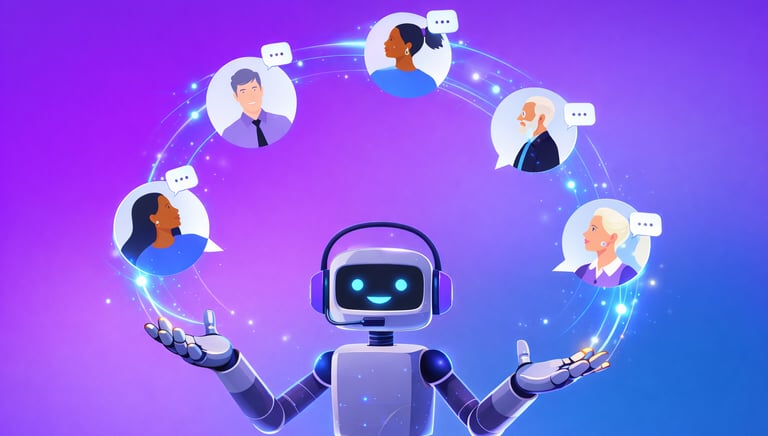
Introduction: AI Voice Agents Aren’t Magic — and That’s Why They Work
AI voice agents are everywhere right now. Demos sound impressive, conversations feel natural, and the promise is always the same: fewer agents, lower costs, instant scale.
But most failed implementations don’t break because the technology is weak.
They fail because expectations are wrong.
AI voice agents are extremely good at certain types of work — and noticeably bad at others. The teams that succeed are not the ones trying to make AI “act human”, but the ones who understand where AI belongs in the call flow and where it doesn’t.
This article breaks that line clearly.
What AI Voice Agents Handle Extremely Well Today
AI voice agents shine in environments that are structured, repetitive, and high-volume. That’s not a limitation — it’s a design advantage.
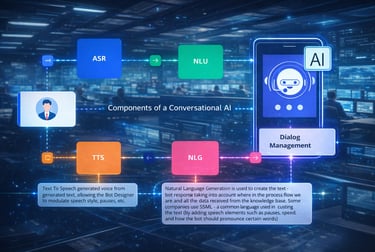
When callers have a clear intent and the path to resolution is known, AI performs with speed and consistency that humans simply can’t match at scale. Tasks like appointment scheduling, order status, balance checks, identity verification, or lead qualification are ideal examples. The agent doesn’t get tired, doesn’t forget steps, and doesn’t vary its answers depending on mood or workload.
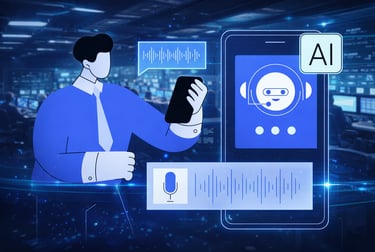
Another area where AI excels is first contact handling. Instead of forcing callers through rigid IVR trees, voice agents can ask open-ended questions, understand intent, and route or resolve requests conversationally. For customers, this already feels like a massive improvement — even when the AI eventually escalates to a human.
Most importantly, AI voice agents are excellent at handling volume spikes. After-hours calls, seasonal demand, campaigns, or unexpected surges are situations where AI absorbs pressure instantly, protecting both CX and agent sanity.
Where AI Voice Agents Still Struggle (And Likely Will for a While)
Despite how natural they sound, AI voice agents are not humans — and that becomes obvious in emotionally charged or ambiguous situations.
Calls involving distress, anger, grief, or complex personal context still require human judgment. AI can simulate empathy, but it doesn’t truly understand emotional nuance, power dynamics, or when a situation needs flexibility instead of efficiency. In those moments, speed is less important than trust.
AI also struggles with cross-domain complexity. When a single issue spans billing, technical support, exceptions, and policy interpretation, humans improvise. They connect dots, break rules when necessary, and resolve edge cases that were never anticipated in a flow design.
Another limitation is accountability. When something goes wrong — misinformation, a wrong promise, or a sensitive misunderstanding — customers expect ownership. Humans can recognize mistakes, apologize sincerely, and adjust in real time. AI cannot truly take responsibility in the same way.
These aren’t bugs. They’re boundaries.
The Real Risk: Overestimating What AI Should Do
Most negative customer experiences with AI voice agents come from over-automation, not from AI itself.
When teams try to push AI into scenarios it’s not designed for — complex complaints, high-stakes decisions, emotionally loaded conversations — the result is frustration loops, broken trust, and higher escalation costs later.
The problem isn’t that AI can’t do everything.
The problem is believing it should.
Successful teams design clear exit paths, transparent escalation, and strict use-case boundaries. They treat AI as a specialist, not a generalist.
Why the Best Call Centers Design for Hybrid, Not Replacement
The strongest call centers aren’t asking “How much can we automate?”
They’re asking “Where does AI add value without damaging trust?”
In practice, that means AI handles the predictable, repetitive, and time-sensitive work — while humans focus on judgment, empathy, and complex resolution. This division reduces burnout, improves consistency, and raises overall service quality.
Agents stop being stuck in loops of low-value calls and instead become problem solvers, not menu navigators. Customers get faster answers and real help when it matters.
Hybrid models aren’t a compromise. They’re a strategy.
IVR vs AI Voice Agents: Why This Shift Matters
Traditional IVRs were built to route calls away from humans. AI voice agents are built to resolve them.
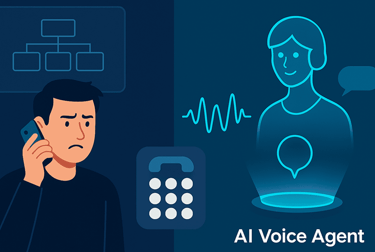
IVRs reset context, force callers to adapt, and punish ambiguity. AI voice agents adapt to the caller, ask follow-up questions, and carry context forward — even when escalating.
This is why many customers are more tolerant of AI than IVR. They don’t want recordings. They want progress.
Final Thoughts: Limits Don’t Weaken AI — They Make It Useful
AI voice agents are not here to replace your team.
They’re here to protect it.
When used within their strengths, they reduce friction, absorb volume, and make support more scalable without eroding CX. When pushed beyond their limits, they become a liability.
Knowing what AI can’t handle yet isn’t pessimism — it’s operational maturity.
Can AI voice agents fully replace human agents?
No — and they shouldn’t. The best results come from hybrid models where AI handles volume and humans handle complexity and emotion.
FAQs
What types of calls should never be automated?
Highly emotional, ambiguous, or high-risk calls where judgment, flexibility, or accountability matter.
Are customers comfortable talking to AI?
More than with IVR — especially when the AI is transparent and escalation is easy.
What’s the biggest mistake teams make with voice AI?
Trying to automate conversations before fixing workflows and escalation design.
About ManuOps
This blog explores how artificial intelligence is improving modern call centers, with a focus on real-world applications, customer experience, and human–AI collaboration.
Contact
Questions? Reach out anytime.
Links
contact@manuops.io
© 2025 ManuOps. All rights reserved.