
How AI Reduces Call Center Costs (Real-World Scenarios)
Discover how AI reduces call center costs through automation, real-world scenarios, and smarter workflows without hurting customer experience.


For many years, reducing call center costs meant making painful trade-offs. Organizations often tried to cut staff, outsource operations, or lower service standards. While these approaches sometimes delivered short-term savings, they also created long-term issues such as frustrated customers, burned-out agents, and declining brand trust.
Today, that model no longer works.
Artificial Intelligence (AI) is changing how call centers reduce costs by targeting inefficiency at its source. Instead of cutting corners, AI allows organizations to redesign operations so that repetitive work is automated, human effort is focused where it adds the most value, and resources scale intelligently with demand.
This article explores how AI reduces call center costs in real-world scenarios, which cost drivers it directly impacts, and why leading organizations are lowering expenses while improving performance at the same time.
Why Call Center Costs Keep Rising
Before understanding how AI reduces costs, it’s important to understand why traditional call center expenses continue to grow.
Labor remains the largest cost driver. Salaries, benefits, onboarding, training, and supervision increase every time call volume rises. As customer expectations shift toward faster and more personalized service, many call centers respond by hiring more agents—driving costs even higher.
Operational expenses add another layer of pressure. Telephony systems, CRM platforms, quality assurance tools, compliance requirements, and reporting infrastructure all scale with interaction volume. Hidden costs such as agent turnover, long average handle times, misrouted calls, and seasonal spikes further inflate budgets.
In this environment, simply working harder is not enough. Cost reduction requires a structural change.
How AI Changes the Cost Structure of Call Centers
AI reduces call center costs by removing inefficiencies built into manual workflows.
Instead of relying entirely on human agents, AI systems:
Handle large portions of customer demand automatically
Resolve routine inquiries instantly
Route complex issues intelligently to the right agent with full context
During live conversations, AI further reduces costs by:
Providing real-time agent assistance
Retrieving relevant customer data automatically
Transcribing calls and generating summaries
Reducing after-call administrative work
These time savings, multiplied across thousands of interactions, result in significant cost reductions. Most importantly, AI allows call centers to scale without increasing headcount at the same rate, breaking the direct link between growth and labor costs.
From Manual Workflows to Intelligent Automation
One of the biggest cost drains in traditional call centers is repetition. Agents spend a large portion of their day answering the same questions, verifying information, navigating multiple systems, and documenting calls after they end.
AI automates these workflows end-to-end. Customers can resolve common issues through natural conversations with AI systems, without waiting on hold. When a call reaches a human agent, AI has already identified intent, pulled relevant data, and summarized previous interactions.
This shift dramatically reduces average handle time, lowers call volumes, and minimizes rework caused by errors or missing information.
Real-World Scenarios Where AI Cuts Costs
Common scenarios include:
Self-service automation, which resolves repetitive inquiries before they reach agents
Intelligent call routing, ensuring customers reach the right agent on the first attempt
AI-generated call summaries, eliminating manual note-taking
Workforce forecasting, helping avoid overstaffing during slow periods and understaffing during peaks
Cost Reduction Without Losing Service Quality
A common concern is that reducing costs automatically leads to worse customer experience. In practice, AI often improves service quality while lowering expenses.
Customers receive faster responses, clearer answers, and fewer transfers. Agents are no longer overwhelmed by repetitive work and can focus on complex or emotional interactions where empathy and judgment matter most.
By standardizing routine interactions and supporting agents with real-time insights, AI creates more consistent experiences across channels. This stability reduces churn, repeat contacts, and long-term revenue loss—costs that are often harder to measure but just as impactful.
Measuring the Real Impact of AI on Costs
Effective cost reduction with AI depends on measurement.
Organizations typically track metrics such as:
Cost per call or cost per ticket
Average handle time (AHT)
Call deflection rate
First-contact resolution (FCR)
Agent productivity
As AI adoption increases, cost per interaction decreases because more requests are resolved automatically and human-handled calls become more focused and efficient. Even though the remaining calls may be more complex, overall operational efficiency improves and ROI compounds over time.
AI delivers its strongest financial impact not through a single feature, but through continuous optimization across the entire call center operation.
Conclusion: Smarter Operations, Sustainable Savings
Reducing call center costs no longer requires sacrificing quality or exhausting teams. AI enables a smarter operating model where automation handles repetition, humans focus on nuance, and efficiency improves across the board.
The organizations seeing the greatest impact are not those that automate everything, but those that apply AI deliberately to real-world problems. By starting with clear cost drivers, measuring results, and expanding gradually, call centers can transform cost reduction from a reactive necessity into a sustainable competitive advantage.
AI doesn’t just cut costs.
It changes how call centers work.
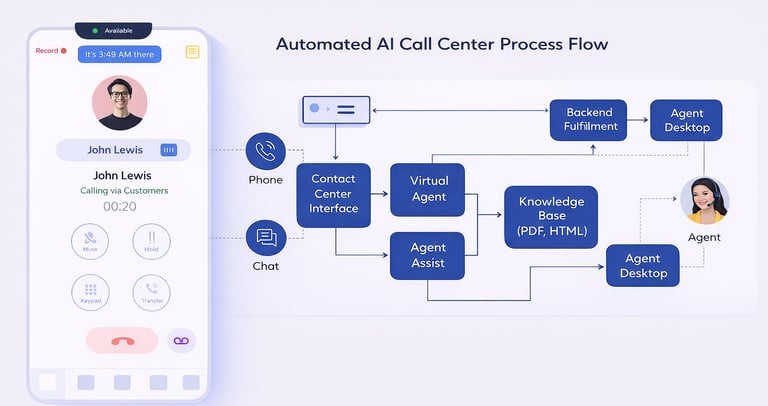
In real call center environments, AI-driven cost reduction appears in practical and measurable ways.
Many organizations also use AI to extend service availability by:
Providing 24/7 coverage for routine requests
Escalating only complex or sensitive issues to human agents
This reduces overtime, outsourcing expenses, and after-hours staffing costs without sacrificing availability.
Does AI really reduce call center costs?
Yes. AI reduces costs by automating repetitive interactions, improving routing accuracy, reducing handling time, and lowering staffing requirements for routine work.
FAQs
How much can AI save a call center?
Savings vary by volume and use case, but many organizations see long-term reductions of 20–40% in operational costs when AI is implemented strategically.
Will AI hurt customer experience?
When implemented correctly, AI improves experience by reducing wait times, increasing consistency, and freeing human agents to focus on complex interactions.
Which interactions should be automated first?
High-volume, low-complexity requests such as FAQs, order status checks, and scheduling are the best starting point.
Is AI only suitable for large call centers?
No. Small and mid-sized call centers often see faster ROI because automation allows them to scale efficiently without aggressive hiring.
How long does it take to see ROI after implementing AI?
While timelines vary by use case, many call centers start seeing measurable cost savings within a few months. Early wins usually come from automating high-volume, low-complexity interactions, with ROI increasing as automation expands.


About ManuOps
This blog explores how artificial intelligence is improving modern call centers, with a focus on real-world applications, customer experience, and human–AI collaboration.
Contact
Questions? Reach out anytime.
Links
contact@manuops.io
© 2025 ManuOps. All rights reserved.